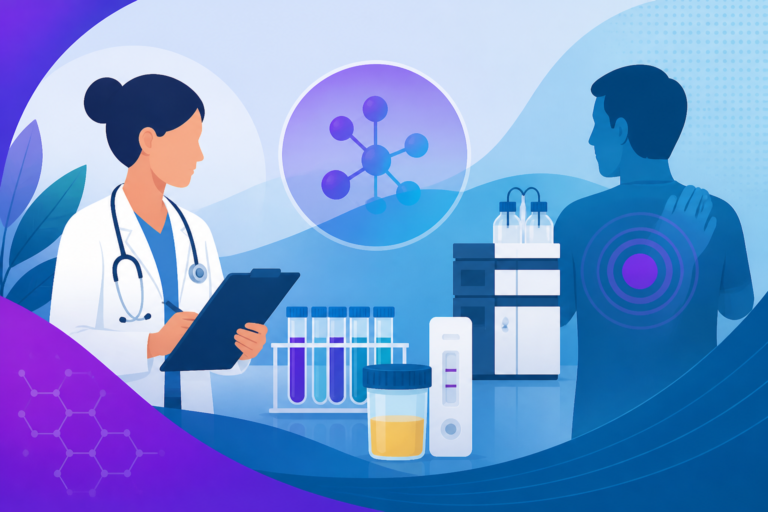


Urine culture has been the standard UTI test for decades, and for a first, uncomplicated infection it still does the job. The trouble starts with the patients who keep coming back: recurrent infections, catheter-associated infections, and residents in long-term care whose symptoms never fully clear. For those patients, PCR testing answers questions culture often cannot.
Where culture falls short
Culture works by growing whatever is in the specimen. That takes time, usually two to three days once identification and susceptibility are included. It also depends on the organism being willing to grow.
- Slow-growing and hard-to-culture organisms can be missed entirely.
- When several organisms are present, the report often comes back as “mixed flora” or “contaminated,” with no organism named.
- A patient who has already started antibiotics may grow nothing at all, even with an active infection.
What PCR adds
PCR detects the DNA of each organism directly, so it does not depend on growth.
- It names every organism it finds. Infections with more than one pathogen are reported as such.
- It reports resistance genes. You see markers linked to resistance against specific antibiotic classes alongside the organisms.
- It is faster. At Total Lab Solutions, UTI PCR results are reported within 48 hours of receipt.
Our basic UTI panel covers 28 bacterial targets. The comprehensive panel adds STI pathogens and Candida species. Both include more than 40 antibiotic resistance markers and run on a single urine specimen.
What PCR does not replace
PCR is a strong tool, and it has limits worth knowing.
- A resistance gene tells you which antibiotics are likely to fail. It is not a full susceptibility profile.
- Detecting an organism’s DNA does not always mean it is causing the symptoms. Results should be read alongside the clinical picture.
- Culture still has a place. You can order culture and sensitivity together with the PCR panel when you want both.
Which patients benefit most
- Recurrent or persistent UTIs
- Complicated infections, including catheter-associated UTIs
- Residents of long-term care facilities
- Patients who failed a first course of antibiotics
- Symptomatic patients with a negative or “mixed flora” culture
Ordering
Collection is a standard urine specimen. We supply the kits, a TLS courier picks up, and results post to the provider portal or your EHR.
To set up UTI PCR testing, call (248) 800-6626 or open a provider account.