
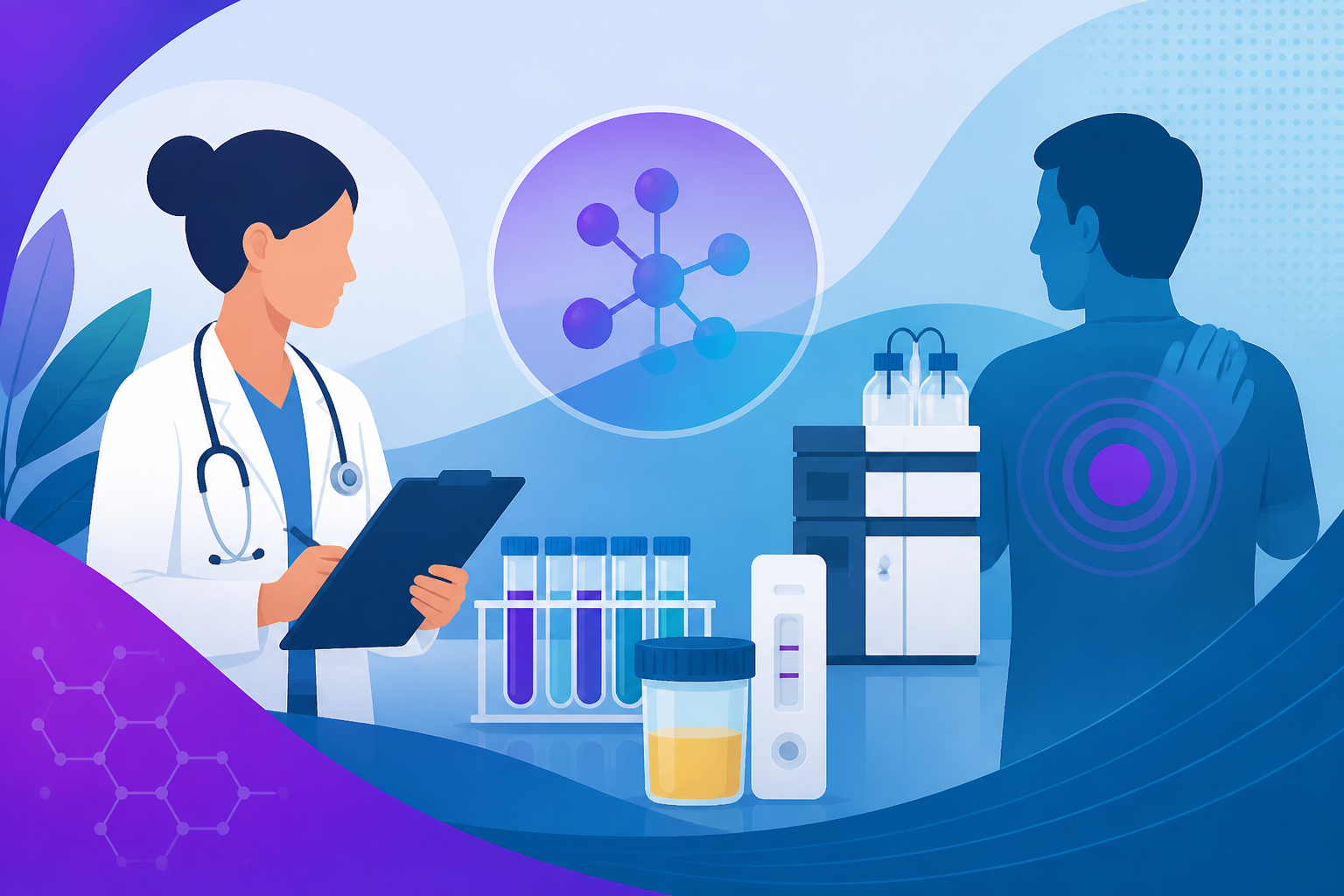
One specimen. Nine targets. A flagged result against a stated cutoff for every analyte. The urine drug screen (UDS, also called a presumptive drug screen) is a toxicology test ordered to check for drugs and alcohol in urine. Specimen validity testing is part of the workflow. Addiction medicine, pain management and long-term care prescribers use it to document adherence, set a baseline and decide whether definitive testing is needed.
At a glance
| Detail | Information |
|---|---|
| Test name | Urine Drug Screen (Drugs of Abuse Screen) |
| Also known as | UDS, presumptive drug screen |
| Category | Toxicology |
| Specimen | Urine (with specimen validity testing) |
| Turnaround | 24 to 48 hours from receipt |
| Ordered by | Addiction medicine, pain management, nursing homes and long-term care, and other prescribers |
What it detects
The panel reports nine targets. Each is flagged Positive or Negative against the cutoff printed on your report.
| Target | Cutoff |
|---|---|
| Amphetamines | <100 ng/mL |
| Barbiturates | <200 ng/mL |
| Benzodiazepines | <200 ng/mL |
| Opiates | <300 ng/mL |
| Cannabinoids (THC) | <50 ng/mL |
| Cocaine | <300 ng/mL |
| Heroin metabolite (6-AM) | <10 ng/mL |
| Phencyclidine (PCP) | <25 ng/mL |
| Ethanol | <50.0 mg/dL |
A presumptive screen tells you whether a drug class is present above the cutoff. It does not identify the individual drug. Definitive testing does that (see the FAQ below).
When to order it
Order it when a result will change what you do next. Typical scenarios:
- Medication monitoring in pain management. Document adherence and identify non-prescribed substances in patients on controlled substances. See our guide to Pain Management Toxicology Testing.
- Addiction medicine. Establish a baseline, then monitor ongoing care. Testing is a tool for recovery, never punishment.
- Nursing homes and long-term care. Monitor residents on controlled substances. Our lab services for skilled nursing facilities are set up for this setting.
- Safety and risk review. Identify overdose risk and dangerous drug-drug interactions, or prevent unsafe interactions during surgery or procedures.
- Pregnancy. Identify patients who are pregnant, or planning pregnancy, and using drugs or alcohol. Early detection of at-risk neonates is also a monitoring goal.
- Regulatory and payer documentation. Record adherence for compliance and payer requirements.
Our monitoring rationale draws on the CDC Clinical Practice Guideline for Prescribing Opioids (2022) and ASAM guidance on the appropriate use of drug testing in clinical addiction medicine.
Specimen collection
The specimen is urine, tested with specimen validity testing. Validity testing is performed on all specimens unless you opt out on the requisition.
Container type, collection volume, handling, storage and chain-of-custody procedures are not specified in the documents supporting this page. For collection supplies and transport instructions, contact us.
On the requisition, you choose one of two order types:
- Urine Drug Screen w/Reflex. Positive screens go on to definitive testing.
- Urine Drug Screen Only.
Either option lets you remove THC or EtS/G from the order. Point-of-care (POC) results can be recorded on the form. You can reflex positive POC results or confirm prescribed negative POC results. ICD-10 diagnosis codes are required on the requisition.
Understanding the report
Each analyte appears on its own line with units, a flag and the cutoff:
- Units: ng/mL for drug targets, mg/dL for ethanol.
- Flag: Positive results are highlighted in red. Negative results are flagged Negative.
- Cutoff: The reference cutoff is printed next to every result, so you can see exactly what threshold was applied.
- Historical trending: The sample report includes a chart of prior results by date, with series for ethanol, oxycodone, oxymorphone, diazepam, amphetamine, 6-MAM and PCP.
- Definitive results: Reports with definitive testing include a "Detailed Definitive Results" section.
You act on the summary. The detail is there when you need it.
Why order it from Total Lab Solutions
- Validity testing on every specimen. It is performed by default. Opting out requires an explicit selection on the requisition.
- Reflex to definitive testing. One order can carry a positive screen through to confirmation. Definitive testing is offered by LC/MS across 1-7, 8-14, 15-21 and 22 or more drug classes.
- Defined cutoffs on every line. The threshold is on the report, so you do not have to look it up.
- Trending built into the report. Prior results are charted alongside the current one.
Frequently asked questions
What is the difference between a presumptive urine drug screen and definitive (confirmatory) drug testing, and when should each be ordered?
A presumptive screen, such as this panel, flags drug classes above a cutoff. Definitive testing identifies and quantifies specific drugs and metabolites by LC/MS. Order the screen for baseline and routine monitoring. Add definitive testing when a positive needs to be identified, or when a negative result for a prescribed medication needs confirming. The reflex option on the requisition sends positive screens to definitive testing automatically. Order definitive testing alone when you know which analytes you need.
Which drug classes are included in your urine drug screen panel, and what are the cutoff concentrations?
The panel covers amphetamines (<100 ng/mL), barbiturates (<200 ng/mL), benzodiazepines (<200 ng/mL), opiates (<300 ng/mL), cannabinoids/THC (<50 ng/mL), cocaine (<300 ng/mL), heroin metabolite 6-AM (<10 ng/mL), PCP (<25 ng/mL) and ethanol (<50.0 mg/dL). These cutoffs are taken from our sample report. Definitive testing uses separate cutoffs.
What is the typical turnaround time for urine drug screen results, and do you offer STAT or same-day reporting?
TLS states a general turnaround of under 24 to 48 hours from receipt. STAT or same-day options are not documented here. Contact us if you need to confirm timing for your account.
How should urine specimens be collected, labeled, and transported to ensure valid results and maintain chain of custody if needed?
Collection volume, container, labeling, transport and chain-of-custody requirements are not specified in our current documentation. Contact the lab for supplies and instructions before you collect. Complete the requisition fully, including the required ICD-10 codes, and make your validity testing selection.
What factors can cause false-positive or false-negative urine drug screen results, and how does the lab assess specimen validity such as creatinine, pH, and adulterants?
Validity testing on our requisition menu includes pH, specific gravity and creatinine. It is performed on all specimens unless you opt out. Our documents do not describe adulterant testing, so it is not covered here.
Source drugs and metabolism can also affect interpretation:
- Methamphetamine can come from a Vicks inhaler, from selegiline metabolism or from illicit D-isomer use, and it is metabolized to amphetamine. D/L isomer testing for methamphetamine is available.
- 6-MAM indicates heroin and is metabolized to morphine.
Detection windows vary by drug. In our urine test menu, amphetamine is listed at 3-5 days, cocaine (benzoylecgonine) at 1-4 days, PCP at 5-7 days and 6-MAM at 24 hours. THC can last up to 30 days with chronic use. Because a presumptive screen is not drug-specific, confirm unexpected results with definitive testing before you act on them.
See our Testing Panel page for other available tests. Your next step: build the order, then let the report tell you what to do.