
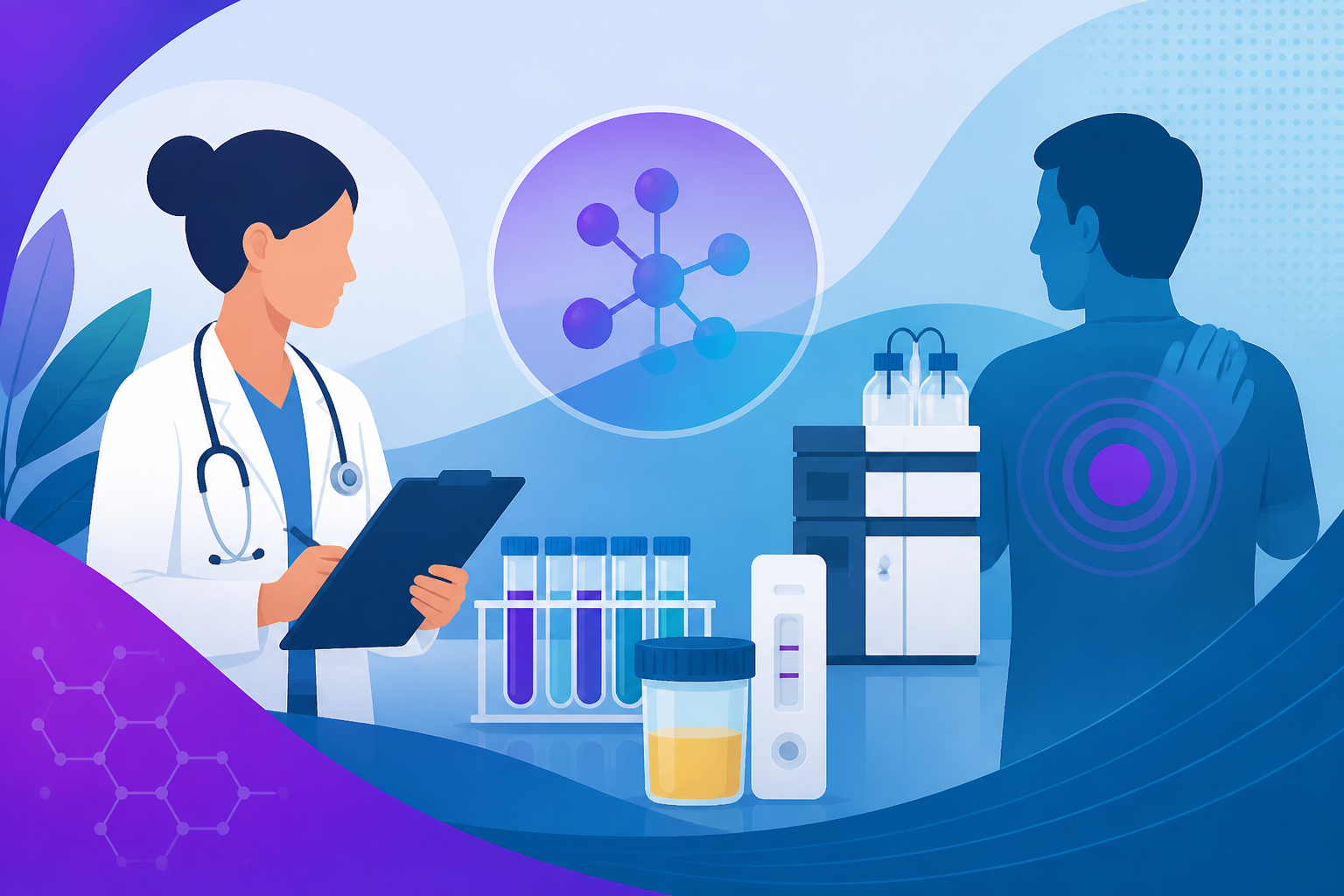
Pain management toxicology testing is a medication-monitoring tool. Clinics use it to confirm that prescribed medications are present and to identify substances that could affect a treatment plan. It supports the clinician’s judgment and is never a standalone verdict on a patient. This guide explains what a pain clinic drug test looks for, how screening and confirmation differ, and how to choose a lab partner.
Key takeaways
- Pain management toxicology testing works best as one part of a broader monitoring program, alongside history, exam, and clinical judgment.
- Panels vary by clinic and lab. What gets tested depends on what the provider orders, so patients and staff should confirm details with the clinic.
- Presumptive screens are useful, but unexpected results are often confirmed with definitive methods such as LC-MS/MS.
- Reliable results depend on standardized collection, specimen validity checks, and a CAP-accredited, CLIA-certified laboratory.
- Testing frequency is set by clinic policy, clinical judgment, and patient risk factors, not by one universal rule.
Why Pain Management Clinics Use Toxicology Testing
Toxicology testing gives clinicians objective information about which substances are present in a specimen. In pain care, that information helps them see whether a patient’s medication use matches the treatment plan. It is one data point, reviewed in context.
Testing as part of a monitoring program
Most clinics fold testing into a written monitoring policy that also covers treatment agreements, prescription monitoring program checks, pill counts, and regular follow-up. Common goals include:
- Confirming that prescribed medications are present
- Identifying substances that may affect safety or the treatment plan
- Supporting consistent documentation and safety practices
Clinic policy, state rules, and payer rules all shape these protocols. The clinician makes every treatment decision, and the lab’s role is to produce accurate, clearly reported data.
What testing does and does not tell a clinician
A result shows whether a substance or metabolite was detected above a cutoff in a specimen. It does not show how much a patient took, exactly when, or why. It also does not diagnose a condition or measure impairment.
Patients often worry about privacy, fairness, or whether they are "in trouble." A neutral framing helps: the test is a routine safety and documentation step, and results are reviewed by a clinician who can ask questions and consider the full picture.
What Is Tested in a Pain Management Drug Test Panel
A pain management drug test panel is not a fixed national standard. Categories commonly include opiates and opioids, benzodiazepines, stimulants, cannabinoids, muscle relaxants, gabapentinoids, antidepressants, and alcohol markers. Each clinic and lab builds its own menu.
Panels are usually customized to the patient’s prescribed medications and the clinic’s risk assessment. A patient on buprenorphine, for example, may need different analytes than a patient on a long-acting opioid or on non-opioid therapy. The table below is illustrative, not a standard panel.
| Drug class | Example analytes (illustrative) |
|---|---|
| Opiates and opioids | Morphine, codeine, hydrocodone, oxycodone, oxymorphone, methadone and its metabolite, fentanyl and norfentanyl, tramadol |
| Buprenorphine | Buprenorphine, norbuprenorphine |
| Benzodiazepines | Alprazolam metabolite, lorazepam, clonazepam metabolite, diazepam metabolites |
| Stimulants | Amphetamine, methamphetamine, cocaine metabolite |
| Cannabinoids | THC metabolite |
| Muscle relaxants | Carisoprodol and meprobamate, cyclobenzaprine, baclofen |
| Gabapentinoids | Gabapentin, pregabalin |
| Antidepressants | Amitriptyline, nortriptyline, other agents per menu |
| Alcohol markers | Ethyl glucuronide (EtG), ethyl sulfate (EtS) |
Prescribed medications and metabolites
Many tests look for both a parent drug and its metabolites. Metabolites help clinicians interpret whether a finding is consistent with a prescribed medication, because some drugs convert into others in the body. For example, a patient taking one opioid may legitimately show a related metabolite.
Illicit and non-prescribed substances
Panels may also include substances a clinic does not expect to see, such as non-prescribed stimulants, synthetic opioids, or other controlled substances. Which of these are included depends on the clinic’s risk assessment and local patterns. Providers should review their menu periodically to be sure it fits their patient population.
Marijuana, alcohol, and kratom: what to know
Patients commonly ask whether a pain clinic tests for marijuana, alcohol, or kratom. The careful answer is that it depends on what the provider orders. Cannabinoid testing is common on many panels, while alcohol is typically assessed with specific markers like EtG and EtS. Kratom usually requires a specialty assay and is not part of every panel. Patients should ask their clinic what their panel includes.
Toxicology Testing Methods: Screening vs. Confirmation
Understanding the difference between urine drug screen and confirmation testing helps both staff and patients read results correctly. Most programs use a two-tier approach: a presumptive screen, then definitive testing when needed.
Presumptive (screening) tests
Presumptive tests are typically immunoassays, run either on point-of-care cups in the clinic or on laboratory analyzers. They are fast and cost-effective for broad class detection. Their limits are well known:
- Cross-reactivity: an antibody may react to structurally similar compounds, producing a false positive.
- Cutoffs: a substance below the cutoff may not be flagged, producing a false negative.
- Class-level detection: some drugs within a class are poorly detected by a given immunoassay.
For these reasons, a presumptive result is best treated as preliminary.
Definitive (confirmation) testing
Definitive testing uses chromatographic methods, most commonly LC-MS/MS and in some cases GC-MS. These methods identify specific compounds and can distinguish between drugs that look alike on an immunoassay. LC-MS/MS confirmation testing is widely used when a result is unexpected, when a patient disputes a screen, or when the clinic’s policy calls for definitive testing of certain medications.
Because these toxicology testing methods are more specific, they help clinicians separate a true unexpected finding from an assay artifact. Timing depends on the lab, the test menu, and logistics, so ask your lab for details rather than assuming.
Specimen validity checks
Urine is the most common specimen, and some programs also use oral fluid or other matrices. Validity checks help confirm that a specimen is genuine and unaltered. Common checks include creatinine, specimen temperature at collection, and other integrity indicators. A specimen that fails validity checks is hard to interpret, which is why collection procedures matter as much as the analysis.
Laboratory quality systems matter here too. A CAP-accredited laboratory is inspected against defined standards, and a CLIA-certified laboratory operates under the federal framework described by the Centers for Medicare & Medicaid Services. Together they signal that quality controls, personnel qualifications, and procedures are in place.
How Often Is Pain Management Toxicology Testing Done?
There is no universal rule. When patients ask whether a pain clinic tests on the first visit or at every visit, the answer is that frequency is set by clinic policy, clinical judgment, and patient risk factors. Professional guidance and payer policies may inform protocols, and they change, so providers should check current sources rather than assume.
Baseline testing at intake
Many clinics collect a baseline specimen at intake or early in treatment. This gives the clinician a reference point for later results and a record of what was present at the start of care.
Routine and random monitoring
Periodic testing during ongoing treatment is common, with the schedule often adjusted to a patient’s risk level. Some clinics use scheduled collections, others use random timing, and many combine both. The key is a consistent written policy that is applied fairly.
For-cause testing
Clinicians may order additional testing when something changes, such as a concerning clinical observation, an unexpected prior result, or a safety question. Documenting the reason helps keep for-cause testing consistent and non-punitive. Providers should verify coverage rules with payers directly, since policies differ.
Collecting Specimens and Getting Reliable Results
Good results start before the specimen reaches the lab. A typical workflow looks like this:
- Review clinic policy and obtain informed consent.
- Collect the specimen following your standardized procedure.
- Label the specimen and complete the requisition accurately.
- Maintain chain of custody where applicable.
- Transport the specimen to the lab.
- The lab accessions and tests the specimen.
- Results are reported to the ordering provider.
Pre-collection steps and patient disclosure
From a patient perspective, a pain clinic panel is ordered by a provider, and patients typically cannot self-order one. Clinics can help by asking patients to disclose all medications, including over-the-counter products and supplements, before collection. A complete list makes later interpretation easier and reduces confusion.
Practical tips for clinics include:
- Use a written, standardized collection procedure for every patient.
- Follow your policy on temperature checks or observed collection.
- Explain the process plainly so patients know what to expect.
- Record medication lists and last-dose information when relevant.
Courier transport and on-site phlebotomy options
Total Lab Solutions offers statewide courier pickup across Michigan, and on-site phlebotomy is available as an option. Availability can vary by location and practice, so confirm directly with the lab whether it fits your setting.
Protecting patient privacy
Toxicology results are sensitive health information. They should be handled in line with HIPAA and accessed through secure channels such as a provider portal. Clinics should also limit who can view results and keep conversations about them private.
Interpreting Results in Pain Management Toxicology Testing
This section is educational and is not medical advice. Clinicians typically review results alongside the medication list, patient history, and what is known about how medications are metabolized. No single result should drive a decision on its own.
Common reasons for unexpected findings
Unexpected results do not always mean what they first appear to mean. General explanations include:
- Metabolites: one drug can produce another detectable compound.
- Timing: detection depends on when a dose was taken and the specimen collected.
- Cross-reactivity: an immunoassay may react to a related compound.
- Specimen issues: dilution, collection errors, or integrity concerns.
This is why confirmation and clinician follow-up matter. A conversation with the patient often clarifies what a number alone cannot.
Where PGx can fit in
Some clinicians use pharmacogenomic (PGx) testing as additional information about how a patient may process certain medications. It is a complement to toxicology, not a replacement, and it does not guarantee any outcome. To read more about how PGx is used in a related specialty, see our overview of PGx testing in psychiatry.
Whatever the result, document it clearly and discuss it respectfully. A non-punitive tone preserves trust and keeps patients engaged in care.
Choosing a Toxicology Lab Partner for Your Pain Clinic
A lab partner affects data quality, workflow, and staff time. Use this checklist when evaluating options:
- CAP accreditation and CLIA certification
- Test menu depth, including screening, confirmation, medication monitoring, and PGx
- Clear, readable reports
- Provider portal access to results
- Responsive support when you have questions
- Logistics such as courier pickup and phlebotomy options
For a deeper walkthrough, see our guide to choosing a toxicology lab for pain management. If you are considering a change, our switching labs checklist outlines what to plan for.
Total Lab Solutions is a CAP-accredited, CLIA-certified independent clinical laboratory in Troy, Michigan serving pain management and behavioral health clinics. We offer statewide courier pickup, optional on-site phlebotomy where available, a provider portal, and a team that answers the phone.
When comparing any lab, including large national labs, reference labs, and academic labs, treat it as a set of questions rather than a ranking. Ask about menu fit, reporting, support access, and logistics for your practice. Confirm on-site phlebotomy availability and turnaround directly with each lab.
Frequently asked questions
What does a pain management drug test look for?
It depends on what the provider orders. Panels commonly cover categories such as opioids, benzodiazepines, stimulants, cannabinoids, muscle relaxants, gabapentinoids, and alcohol markers. Clinics usually tailor the menu to the patient’s prescribed medications.
Does a pain management drug test check for marijuana, alcohol, or kratom?
Cannabinoids are included on many panels, and alcohol is typically assessed with specific markers like EtG and EtS. Kratom generally requires a specialty assay and is not on every panel. Ask your clinic what is included.
What is the difference between a urine drug screen and confirmation testing?
A screen is a presumptive immunoassay that detects drug classes quickly but can cross-react. Confirmation uses methods like LC-MS/MS to identify specific compounds. Unexpected screening results are often confirmed.
Does a pain clinic test on the first visit or every visit?
There is no universal rule. Many clinics collect a baseline at intake and then monitor periodically, with frequency set by policy, clinical judgment, and risk factors.
How do I get a toxicology test done?
A provider orders it, and patients typically cannot self-order a pain clinic panel. Your clinic will explain the collection process and any consent steps.
Does insurance cover pain management toxicology testing?
Coverage varies by payer and plan, so we cannot make general claims. Providers and patients should verify coverage directly with the payer.
Conclusion
Pain management toxicology testing works best as a thoughtful, consistently applied part of a monitoring program, supported by clear collection practices and a laboratory you can reach when questions come up. If you would like to discuss test menus, collection workflow, or courier and phlebotomy options for your clinic, our team is ready to help. Explore our tests.